

The Center for Precision Medicine (CPM) drives breakthroughs that transform patient care. By integrating biomarkers, imaging, spatial omics and advanced analytics with clinical research, CPM enables investigators to cross the “valley of death” between discovery and the clinic—to bridge the gap between discovery and clinical application—and ensure the right patient receives the right therapy at the right time.
From bench to bedside: Translating new discoveries for complex diseases
Why this matters now
- Complex diseases often go untreated
- Treatments will require a molecular diagnosis for individual patients
- Cardiovascular disease, neurodegenerative disease liver, lung and kidney affect 90% of US population with high mortality and poor quality of life
- New omics tools and big data analysis are available for clinical biopsies and clinical samples
- Cancer: In 2025, an estimated 2,041,910 Americans will be diagnosed with cancer and 618,120 will die from it; roughly 38.9% of men and women will be diagnosed at some point in their lifetimes.
- Neurodegenerative disease (Alzheimer’s): About 7.2 million Americans (65+) are living with Alzheimer’s in 2025, and the total is projected to reach ~14 million by 2060.
- Cardiovascular disease: The nation’s leading killer—someone dies about every 34 seconds, and ~805,000 Americans have a heart attack each year.
- Kidney disease: More than 1 in 7 U.S. adults (~35.5M) live with chronic kidney disease and ~360 people begin dialysis every day.
CPM Unique Capabilities
• Integrate spatial omics, imaging and AI with clinical phenotyping to pinpoint disease drivers.
• Move rapidly from hypothesis to human relevance via patient‑centered biobanks and clinical trials.
• Build local, regional and national partnerships, including the Center for Innovative Drug Discovery (CiDD), Institute for Integration of Medicine and Science (IIMS), Center for Brain Health, the Glenn Biggs Institute for Alzheimer’s and Neurodegenerative Diseases, Southwest Research Institute (SwRI®), Texas Biomed, and Mays Cancer Center, to scale discoveries into therapies.
Leadership and Platform
- Director, CPM: Kumar Sharma, MD — Professor, Chief of Nephrology and Vice Chair for Research.
- Co‑Director, CPM: James D. Lechleiter, PhD — Professor of Cell Systems and Anatomy; prior Director, Optical Imaging Core, current co-Leader, Optical Imaging Shared Resource
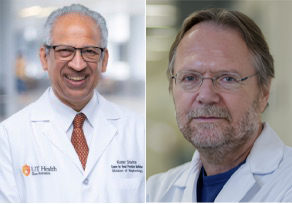
- Strategic partners: Center for Innovative Drug Discovery (CiDD), Institute for the Integration of Medicine and Science (IIMS), University of Texas at San Antonio (UT San Antonio), Southwest Research Institute (SwRI®), Texas Biomed
- Unique capabilities: biomarker discovery/validation, spatial metabolomics, spatial transcriptomics, spatial proteomics, advanced imaging, patient‑centered bioinformatics, clinical trial integration, organoid screening
Key members for biomedical/AI expertise and clinical applications
Biomedical/AI expertise: Daohong Zhao, MD; Guanshi Zhang, PhD; Yaxia Yang, PhD (therapeutics); Kal Clark, MD (radiology and AI); Kate Lawrenson, PhD (spatial transcriptomics, bioinformatics); Simon Gayther, PhD (genomics); Mark Goldberg, MD, PhD (stroke, axonal injury); Amina Qutub, PhD (AI and lymphatics); Agustin Ruiz, PhD (AD multi-omics); Jingyong Ye. PhD (diagnostics, sensors); Aleksandra Gruslova. PhD (vascular calcification); Meredith Zozus, PhD (medical informatics); and Jonathan Gelfond MD, PhD (biostatistics)
Clinicians: Carlayne Jackson, MD (ALS); Allen Anderson, MD (heart failure); Marc Feldman, MD (interventional cardiovascular); Anoop Nambiar, MD (pulmonary); Matt Butler, MD (oncology); Anand Karnad, MD (Hematology); Swetha Kanduri, MD (onco-nephrology and rare diseases); Tareq Nassar, MD (glomerulonephritis); Wajeh Qunibi, MD (vascular calcification); Sarah Lapey, MD (liver disease); Prabhleen Chahal, MD (advanced intervention); Sarwat Gilani, MD; Ram Akilesh, MD (University of Washington); and Jeff Hodgin, MD, Pathology (University of Michigan)
Featured clinical and translational projects
- BRISK: Bupropion for Fatigue in End‑stage Kidney Disease Patients on Hemodialysis — pilot interventional trial; CPM measures active metabolites. (ClinicalTrials.gov NCT06609343)
- OASIS: Oral intradialytic essential amino acids to reduce fatigue, frailty and cognitive burden in dialysis — CPM targeted metabolomics in plasma. (ClinicalTrials.gov NCT05705414)
- Spatial metabolomics in rare renal disease (Dense Deposit Disease) and metabolomics in renal biopsies — defining molecular drivers to inform therapy.
- Post‑hoc precision analysis of SGLT2/SGLT1‑2 inhibitors on urine adenine levels — linking mechanism to patient‑level biomarker change.
Your gift accelerates impact and helps bridge the “valley of death”
Discovery |
| Equip spatial omics & imaging (instruments, assays, data) |
Translation |
| Seed high‑potential pilots (biomarkers, target validation) |
Clinical Impact |
| Launch patient‑focused studies (trials, biobanks, outreach) |
Philanthropic priorities and recognition
- Equip the platform with state-of-the-art technology: Mass spectrometry imaging as instrument improves every 2-3 years, advanced optical imaging, and assay development.
- Accelerate projects: Pilot grants that bridge discovery to first‑in‑human readiness; matching‑gift challenges.
- Power clinical studies: Interventional trials in neurologic diseases, rare cancers, cardiovascular diseases, and rare kidney and liver disease.
- Train talent: Named student/fellowships in AI, precision medicine and data science; visiting scholar lectureships.
- Advance equity: Expand diverse biobanks and community partnerships across South Texas.
Recognition options include Named funds, endowed fellowships, lecture series sponsorships, equipment naming, and symposium support.
Momentum
Recent publications highlighting advances in Precision Medicine
- Nature Reviews Nephrology, 2025: CPM’s manuscript on spatial metabolomics & multi‑omics for kidney precision medicine.
- American Journal of Physiology, 2025: New treatment for acute kidney injury and precision diagnostics
- Nature Reviews Nephrology, 2024: New technologies for precision medicine
- Journal of Clinical Investigation Insight 2024: New therapeutic target for neuroinflammation following kidney injury
- Journal of Clinical Investigation, 2023 New therapeutic and biomarker for kidney failure with diabetes
Additionally: First Annual Symposium on Spatial Omics and Artificial Intelligence, held at UT Health San Antonio, September 2025. Enthusiastic, record audience, hosted by the Center for Precision Medicine.
Scan below to learn more about the Center for Precision Medicine at UT Health San Antonio as well as how you can support or collaborate with us.

Center for Precision Medicine • UT Health San Antonio • 7703 Floyd Curl Drive, San Antonio, TX 78229 • (210) 567‑4700 • cpm@uthscsa.edu