

Elimination of Duration of Status Impact on F-1 and J-1 International Students
Update 9/23/2026
The Department of Homeland Security’s final rule, “Establishing a Fixed Time Period of Admission and an Extension of Stay Procedure for Nonimmigrant Academic Students, Exchange Visitors, and Representatives of Foreign Information Media,” that was set to go into effect on September 15th has been postponed. This is a temporary hold and the OIS will continue to monitor the situation and provide updates to you once a new implementation date becomes clear.
Summary
On July 17, 2026, the U.S. Department of Homeland Security (DHS) published a final rule that will change the way F-1 and J-1 international students are admitted to and maintain status in the United States.
Beginning September 15, 2026, the new rule will replace the current Duration of Status (D/S) framework with a fixed period of admission, Admit Until Date (AUD), and introduce a new Extension of Stay (EOS) process. These changes may affect F-1 and J-1 international students who need additional time to complete their programs.
F-1 and J-1 international students are encouraged to review their program end dates on their Form I-20 or Form DS-2019 form and plan in advance if an extension may be necessary.
Duration of Status (D/S):
When a nonimmigrant enters the United States, a U.S. Customs and Border Protection (CBP) officer determines how long the individual is authorized to stay in the United States. This information is recorded on the individual’s Form I-94.
Instead of having a specific end date on the Form I-94, individuals admitted for D/S could generally remain in the United States as long as they continued to meet the requirements of their F-1 or J-1 status.
For F-1 and J-1 international students, this generally meant:
- Continuing to participate in the approved academic program;
- Maintaining a valid SEVIS record;
- Following the requirements of F-1 and J-1 status; and
- Completing the academic program within the authorized program period listed on the Form I-20 or Form DS-2019.
It is important to understand that the Form I-94 and visa serve different purposes. The visa allows an individual to request entry to the United States, while the Form I-94 shows how long the individual is authorized to remain in the United States after entering.
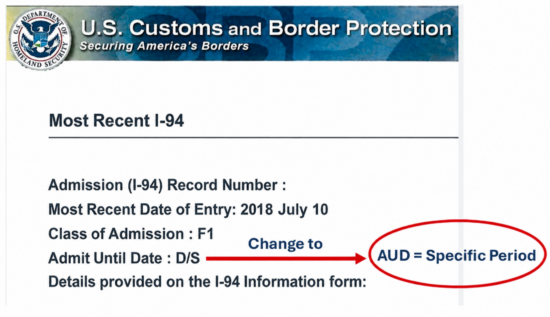
Admit Until Date (AUD):
The Admit Until Date (AUD) is the date on your Form I-94 that indicates when your authorized stay in the United States ends. Beginning September 15, 2026, F-1 and J-1 international students and their dependents will be admitted for a specific period, with an end date listed on their Form I-94. The AUD should include the applicable grace period following the completion of your program.
Extension of Stay (EOS):
An application submitted through Form I-539 to United States Citizenship and Immigration Services (USCIS) to obtain an additional period of authorized stay beyond the approved AUD.
Changes Under the New Rule, effective: September 15, 2026
- Have a specific expiration date on their Form I-94 rather than the “D/S” notation.
- Generally, be admitted through the end date of their program or appointment listed on the Form I-20 or Form DS-2019 plus a 30-day grace period, or for up to four years, whichever comes first.
- Be responsible for checking their Form I-94 and keeping track of their authorized stay.
- Need to take additional steps if they wish to remain in the United States beyond the date on their I-94. Depending on their circumstances, this may involve requesting an extension of stay from USCIS 180 days before the I-94 expires or departing the United States and seeking readmission.
The four-year period generally refers to the maximum length of a single period of admission, not the total amount of time an individual may participate in an F-1 or J-1 academic program in the United States.
For example, some Ph.D. programs require students to complete the program in five years, which is longer than four years listed on the Form I-20 or Form DS-2019. Therefore, at the beginning of the 4th year, students will need to request an extension of stay or travel outside the United States and seek readmission for a new period of authorized stay.
Important: The new rule does not create a four-year lifetime limit on F-1 and J-1 status. Your ability to remain in the United States depends on your continued eligibility for your F-1 and J-1 program and compliance with applicable immigration requirements.
Frequently Asked Questions
How is the 4 years counted?
The 4-year clock begins on the Form I-20 or Form DS-2019 program start date. The 30-day pre-program entry window does not count against the maximum.
Examples:
Fall 2027 PhD Student
Form I-20 start date – August 16, 2027
Form I-20 end date – May 31, 2032
Form I-94 fixed admission date – September 14, 2031 (extension can be filed up to 180 days prior to the Form I-94 fixed admission date)
Fall 2027 Master’s Student:
Form I-20 start date – August 16, 2027
Form I-20 end date – May 31, 2029
Form I-94 fixed admission date – June 30, 2029 (extension can be filed up to 180 days prior to the Form I-94 fixed admission date)
During the transition period, what happens to the Form I-94 admission record and SEVIS record?
Current F-1 and J-1 international students admitted for D/S keep that status until their program end date or 4 years from the rule’s effective date (September 15, 2030), whichever is sooner, unless they travel internationally. Students who timely file for post-completion OPT or STEM OPT within 244 days (March 18, 2027) of the rule’s publication date (July 17, 2026) are exempt from submitting a separate extension of stay application, unless they travel internationally.
What if an F-1 or J-1 student travels internationally?
Starting September 15, 2026, F-1 and J-1 international students who travel abroad will receive a fixed-admission Form I-94 upon re-entry. Any international trip converts a D/S admission to a fixed one. Travel decisions should be made with this in mind.
What if an F-1 or J-1 student finishes the program early?
If an F-1 or J-1 student finishes early, the Designated School Official (DSO) shortens the program end date in SEVIS, triggering the 30-day departure period. Applying for a final semester reduced course load or Post-Completion OPT will result in a shortened Form I-20 program end date. Early completion accelerates the departure clock; coordinate with your DSO before finishing ahead of schedule.
What happens if an F-1 or J-1 student withdraws from the program?
If an F-1 student is authorized to withdraw from classes, a 15-day departure period is triggered (Authorized Early Withdrawal Termination). Program withdrawal accelerates the departure clock even further and should be closely coordinated with a DSO. If a J-1 student is authorized to withdraw from classes, a 30-day departure period is triggered and should also be coordinated with the Alternate Responsible Officer (ARO).
How is the grace period calculated after an F-1 or J-1 student completes the program?
Post-completion departure period reduced from 60 to 30 days for F-1 and J-1 students. Reduced time to change status, apply for OPT/STEM or begin a new program after completion. J-1 students have always had a 30-day grace period.
How are F-2 or J-2 dependents affected?
Dependents may not stay beyond the principal F-1 or J-1’s authorized period of stay, even if their Form I-94 shows a longer admission. Families must file extensions together; a dependent’s longer Form I-94 date cannot be relied upon (Forms I-539 and I-539A can be filed concurrently).
Can F-1 or J-1 undergraduate students transfer institutions or change programs?
Undergraduates cannot transfer or change educational objectives during the first academic year. SEVP may authorize limited exceptions. New students are locked in for year one. Initial transfer-out is no longer possible.
Can F-1 or J-1 graduate students transfer institutions or change programs?
No transfers or changes of educational objective at any point during the program; SEVP may authorize limited exceptions. Graduate students should choose programs carefully; mid-program transfer is no longer possible.
Can F-1 or J-1 students repeat or enroll in lower-level programs?
F-1 students may not pursue a second program at the same level (e.g., a second master’s) or a lower level.
Are there any changes to the USCIS Forms I-539 for Extension of Stay and I-765 Employment Authorization?
Yes. USCIS will release revised editions of Forms I-539 and I-765 on September 15, 2026, in connection with the new rules establishing a fixed period of admission, an Admit Until Date (AUD) on Form I-94. There will be no grace period for the new editions. Applicants filing on or after September 15 must use the 09/15/26 editions.
- Form I-539: Application to Extend/Change Nonimmigrant Status
– USCIS will accept the 08/28/24 edition if it is filed before September 15, 2026.
– USCIS will accept the 09/15/26 edition beginning September 15, 2026.
– The older 08/28/24 edition will not be accepted if filed on or after September 15, 2026. - Form I-765: Application for Employment Authorization
– USCIS will accept the 08/21/25 edition if it is filed before September 15, 2026.
– USCIS will accept the 09/15/26 edition beginning September 15, 2026.
– The older 08/21/25 edition will not be accepted if filed on or after September 15, 2026.
Important: Do not submit the 09/15/26 editions before September 15, 2026. USCIS has made preview versions of both forms and their instructions available so applicants can prepare in advance.
BEFORE FILING: Always check the edition date at the bottom of the Form I-539 and Form I-765 pages on the USCIS website to confirm you are using the correct edition.
Disclaimer
The information and updates provided on this website reflect our best current understanding of the new regulations and are provided for general informational and educational purposes only. This information is subject to change as we receive additional information. We will continually update this website to reflect forthcoming guidance from various agencies on both the interpretation and implementation of the regulations. Information on this webpage does not constitute legal advice. We request that any departments or individuals with immigration related questions regarding the new regulations contact OIS directly at international@uthscsa.edu. We are committed to supporting you through this transition.