

Duration of Status (D/S) Rule Change Summary That Takes Effect September 15, 2026
This summary is based on our initial review and analysis by the Office of International Services of the Department of Homeland Security’s final rule, “Establishing a Fixed Time Period of Admission and an Extension of Stay Procedure for Nonimmigrant Academic Students, Exchange Visitors, and Representatives of Foreign Information Media,” which was published on July 17, 2026.
Since the rule is extensive and has deep ramifications for our F-1 and J-1 scholars, the Office of International Services is still unpacking the lengthy rule and will update our students, Exchange Visitors (EV), departments, and other stakeholders when updates become available, and as our understanding of the rule develops. We encourage students and scholars, and other campus partners to check this page periodically for the latest information.
Rule Overview
General
As previously mentioned, the Department of Homeland Security (DHS) published a final rule in the Federal Register that ends duration of status, or D/S for F, J, and I nonimmigrants. See below for more information regarding D/S.
With the new ruling, F-1 and J-1 nonimmigrants and their dependents will be granted a fixed period of time in the U.S. The effective date for the new rule is September 15, 2026. Starting from that date, F and J nonimmigrants who require additional time to complete their studies, or exchange programs, will be required to submit an Extension of Stay request form to U.S. Citizenship and Immigration Services (USCIS).
If F-1 and J-1 nonimmigrants who were admitted for D/S before September 15, 2026, remain in the U.S. after the new rule goes into effect, they will generally retain their D/S. If they leave and travel internationally and seek re-admittance on or after September 15, 2026, they and their dependents will now be subject to the new rule and lose their D/S status. Similarly, if a student or EV is approved for an Extension of Stay, they will then be given a fixed date and thus lose their D/S.
Duration of Status
Duration of Status is a period of authorized stay in the United States issued to nonimmigrants each time they arrive at a U.S. port of entry and is determined by Customs and Border Protection (CBP). A CBP officer will determine how long the individual can remain in the U.S. and issue the nonimmigrant a from I-94 and admits them to the U.S. Please note that the I-94 and visas are not the same. An I-94 is what governs how long an individual is authorized to remain in the U.S. while a visa is what allows a person to seek admission to the U.S.
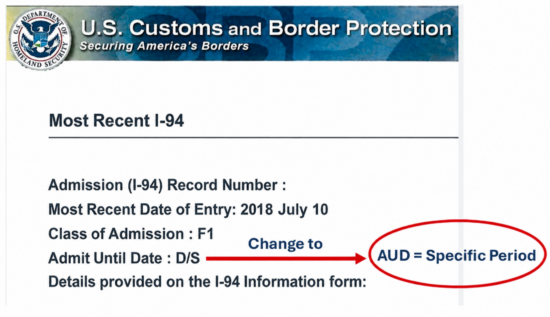
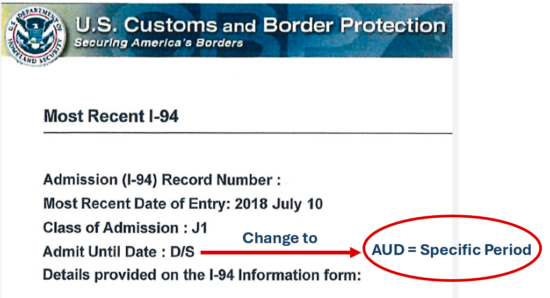
D/S is the admission framework that F-1 students have utilized since its inception in the late 1970s and was later extended to J-1 EVs in the mid-1980s. Since that time, CBP has admitted F-1 and J-1 nonimmigrants for a period that is called “Duration of Stay” and is a nonimmigrants’ lawful stay in the U.S. which is tied to maintaining requirements of their immigration status instead of assigning a specific fixed calendar date that expires. If an F-1 student requires additional time to complete their academic program, for instance, OIS has the authority from the Department of Homeland Security (DHS) to extend a student’s form I-20. This would allow the student to continue in their F-1 lawful status without having to apply to U.S. Citizenship and Immigration Services (USCIS) and complete form I-539 for an Extension of Stay (EOS). Likewise, if a J-1 EV’s program required additional time, then the program sponsor and OIS would work together to extend the EVs form DS-2019. This would allow the EV to remain in lawful J-1 status without filing an EOS with USCIS.
Under the D/S framework, those on F-1 and J-1 visas could transition from one educational level to another—for example, from a bachelor’s in biology, to a Bachelor of Science in Nursing (BSN)—without completing an EOS (I-539) to apply to extend their lawful period of stay.
This was the framework for F-1 and J-1 visa holders in the U.S. since the mid-1980s. Their authorization to stay in the U.S was based on maintaining valid status and not on applying for and being granted extensions of stay which would provide an individual with a fixed admission period. However, starting September 15, 2026, DHS will implement a new framework once the final rule goes into effect. This new rule will replace the D/S admission with a fixed period of stay. It is important to note that the rule will go into effect on September 15, 2026, unless Congress acts. This rule is subject to the Congressional Review Act (CRA) and Congress request to review it before its implementation. However, in practice, it is atypical for Congress to make this request.
Key Provisions: At A Glance
D/S → AUD
Starting September 15, 2026, D/S will end for F-1 students, F-2 dependents, J-1 exchange visitors, and J-2 dependents. From that date onward, they will receive an Admit Until Date (AUD) on their form I-94 instead of D/S. The AUD will specify the length of time the individual is authorized to remain in the U.S.
Individuals admitted on or after the new rules’ effective date will be admitted until the program end date on their Form I-20 or DS 2019, or four years, whichever comes first. This now means that the student and EV must monitor their AUD expiration date during their stay and request an EOS from USCIS (or exit the U.S. and seek re-entry from CBP) it they will remain in the U.S. beyond their authorized period of admission. Our current understanding of the start date of the four years is that it begins on September 15, 2026.
AUD does not limit the total amount of time an individual may study, research, or be an EV in the U.S; it limits the length of an individual’s period of admission. If an F-1 or J-1 requires additional time, they must now obtain an EOS before their AUD expires, or seek another lawful admission by traveling and re-entering the U.S.
Grace Period
- General
All F-1 and J-1 students will be granted a 30-day grace period after completing their program or authorized activity. - 240-Days
Please note that USCIS allows a 240-day grace period for those who have timely applied (before the program end date) for an EOS as they adjudicate from I-539. This is a temporary benefit and allows for a limited continuation of certain employment and program activities (i.e., F-1 and J-1 on-campus employment, F-1 CPT, F-1 severe economic hardship, and employment incident to J-1 status) for up to 240 days when the EOS has been timely filed. However, the scope of activities is narrow. Activities and circumstances outside of the abovementioned ones will not automatically authorize continued employment.
F-1
- Changing Majors
Undergraduate F-1 students will only be allowed to change majors after completing their first year within the academic program. Graduate F-1 students will not be permitted to change their major or education levels at any point during their academic program of study. Except in limited circumstances approved by SEVP, or other extenuating circumstances as determined by DHS. - Transfers
Undergraduate F-1 students may not transfer to another university during their first year but may do so after one school year has elapsed. F-1 Students in graduate school are restricted from transferring. Except in limited circumstances approved by SEVP, or other extenuating circumstances as determined by DHS. - Earning a degree at the same educational level If you are an F-1 whose program begins on or after September 15, 2026, you will be subject to the new rule and thus are not allowed to earn a second degree at the same educational level.
J-1
- Program length
The new rule does not change the maximum program length (i.e. five-year maximum for certain EV categories).
The rule changes the duration that a J-1 and their J-2 dependents are admitted at one time and not the maximum duration that a participant is allowed to participate under the EV program. If additional time is needed for the EV to complete their program beyond the AUD, they will need to complete an EOS and pay the fee to USCIS.
What Actions Should Be Taken At Present
- F-1 Students and J-1 Exchange Visitors
- Attend OIS Information Sessions – OIS has been sending email invites to virtual information session to all F-1 and J-1 students, including those on post-completion OPT, STEM, and Academic Training and to the J-1 exchange visitors (researchers and alien physicians). See the Events page for future sessions.
- Review information on the duration of status and past presentations housed on the OIS SharePoint site (must use credentials to access MyUTHealth).
- Review your Form I-20/DS-2019 end date. If an extension is needed, please work with your OIS advisor and they will provide you with next steps on how to request this action.
- Work with an OIS advisor before taking any action as it relates to program changes, international travel, or work authorization.
- If you do travel abroad after September 15, 2026, always remember to review your I-94 after re-entering and provide a copy to your F-1/J-1 student advisor or for the J-1 exchange visitors (researchers and alien physicians), submit the Update Immigration Documents request via the Scholar International Portal.
- Academic Programs, Hosting/Hiring Departments, and Training Programs
- Attend OIS Information Sessions – See the Events page for future sessions. OIS has been sending email invites, please be checking your email. If you did not receive on and wish to attend, please email international@uthscsa.edu.
- Do not provide immigration advising. OIS asks that you refer your F-1/J-1 student or J-1 exchange visitor to our office. You may also direct your student or exchange visitor to review our information on the duration of status via the links below, view past presentations housed on the OIS SharePoint site (must use credentials to access MyUTHealth), attend upcoming information sessions that our office hosts, or simply make an appointment to speak with an OIS advisor.
Resources:
- ECFMG Division of Intealth: Update on U.S. Department of Homeland Security Rule to End Duration of Status Framework for J, F, and I Visa Holders
- Fragomen: United States: DHS Issues Final Rule Replacing Admission for Duration of Status with Fixed Periods of Stay for F, J, and I Nonimmigrants
- Klasko Immigration Law Partners, LLP: DHS Finalizes Rule Eliminating Duration of Status for F, J, and I Nonimmigrants
- NAFSA: Duration of Status Rule
- Olgetree Deakins: DHS Publishes Final Rule Replacing Duration of Status With Fixed Admission Periods for F, J, and I Nonimmigrants
- Study in the States: Final Rule: Establishing a Fixed Time Period of Admission and An Extension of Stay Procedure Quick Facts
Disclaimer
The information and updates provided on this website reflect our best current understanding of the new regulations and are provided for general informational and educational purposes only. This information is subject to change as we receive additional information. We will continually update this website to reflect forthcoming guidance from various agencies on both the interpretation and implementation of the regulations. Information on this webpage does not constitute legal advice. We request that any departments or individuals with immigration related questions regarding the new regulations contact OIS directly at international@uthscsa.edu. We are committed to supporting you through this transition.